ENTSO-E Report about Czech Grid Incident
The ENTSO-E Expert Panel investigating the grid incident in the Czech Republic on 4 July 2025 has published its final report, identifying the root causes of the event and outlines recommendations aimed at preventing similar incidents in the future.
The Expert Panel was composed of 17 representatives from Transmission System Operators (TSOs), the Agency for Cooperation of European Energy Regulators (ACER), and National Regulatory Authorities (NRAs), and was chaired by an expert from an unaffected TSO.
What happened?
On 4 July 2025, the Czech transmission system experienced a major disturbance due to an unexpected reduction of generation in one part of the system which followed the tripping of a 400 kV line, caused by a broken wire. A couple of minutes after the N-1 event, this unexpected reduction in generation led to increasing overloads in the transmission grid. An overloaded 220 kV line was disconnected, triggering the tripping of the two remaining connection points in the affected area, which was subsequently islanded. Due to the large generation-load imbalance in this area, the automatic under-frequency load shedding was unable to prevent the frequency drop, leading to the immediate collapse of the islanded area and the loss of approximately 2,300 MW of load, corresponding to around 28% of demand in the ČEPS control area.
Recommendations
Based on its findings, the Expert Panel proposed a series of recommendations to improve operational resilience and reduce the risk of similar events in the future. These include:
- Strengthen verification and quality assurance for work on the transmission network, with a particular focus on emergency repairs and work affecting the mechanical integrity of primary equipment
- Assess and mitigate the risk of distributed generation disconnection after transient events
- Review transition to droop speed control mode (IO mode) logic and frequency protection delay, where applicable
- Enhance the decision support for control room operators with real-time assessment and visualization tools to identify the cascading risk.
- Review and operationalize the system defence plan procedures for preventing the escalation of the incident, and ensure they include all technically possible measures, and that the measures are executable in practice where relevant.
- Review the thresholds and technologies providing automatic response to frequency deviations
- Storing the data of online N-1 calculations
Find the full reporthere


No results found
-
15 June 2026
Webinar Strengthening Energy Systems
On Wednesday, May 13, 2026, Arya Fazilat, Advisor for Digitalization of System Operations and MCCS Labs at 50Hertz spoke – in a webinar hosted by IPFA. -
03 June 2026
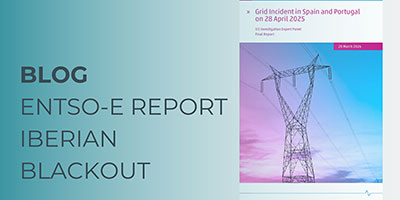
ENTSO-E Report about Iberian Blackout
The Expert Panel set up by ENTSO-E to investigate the 28th April 2025 Iberian Blackout published the final report on the 20th of March 2026. The report analyses the root causes of the incident and presents recommendations to strengthen the resilience of Europe’s interconnected electricity system. -
03 June 2026
Podcast – Who keeps the Power-Grid in Balance?
In this podcast episode, Anne-Katrin Marten, Director of System Operations, and Mirko Pracht, Director of Digitalization of System Operations and Modular Control Center System, discuss with Volker Gustedt, Spokesperson at 50Hertz, how the power system is controlled today – and how it will be kept in balance in the future.