Podcast – Who keeps the Power-Grid in Balance?
In this podcast episode, Anne-Katrin Marten, Director of System Operations, and Mirko Pracht, Director of Digitalization of System Operations and Modular Control Center System, discuss with Volker Gustedt, Spokesperson at 50Hertz, how the power system is controlled today – and how it will be kept in balance in the future.
System operations at a transmission system operator can be compared to the cockpit of an aircraft. However, rather than guiding a single plane, operators manage the backbone of electricity supply for millions of people. In a highly secure control room that resembles a space operations center, experienced specialists monitor the grid around the clock. Large-scale displays provide a real-time overview of power flows, potential bottlenecks, and areas where intervention is required to maintain system stability.
At the heart of these operations is the control system – a digital nervous system that collects and visualizes data from across the grid in real time. It provides continuous insights into voltage levels, power flows, frequency deviations, and the status of every transmission line and substation. Based on this information, system operators actively manage the grid whenever necessary. They can switch lines on or off, adjust the output of wind and solar generation, and request the dispatch of conventional power plants.
Forecasting tools play a critical role in this process. Advanced software solutions calculate expected generation from wind and solar sources, predict consumption patterns, and identify potential congestion in the hours and days ahead. These forecasts function much like a weather report for the grid, enabling operators to prepare early and minimize operational risks.
When the system risks losing balance – due to sudden changes in demand, generation outages, grid overloads, or imbalances in balancing groups – operators rely on balancing energy and redispatch measures. Balancing energy acts as a short-term buffer, increasing generation or reducing demand to keep the system frequency stable at 50 hertz. Redispatch involves the targeted adjustment of power plant output to prevent grid congestion, similar to rerouting traffic to avoid a highway bottleneck.
Coordination extends beyond national borders. Through European platforms such as ENTSO-E, system operators exchange data, align their actions, and implement cross-border measures. Since the electricity grid operates as an interconnected system, effective collaboration across countries is essential.
As the share of renewable energy continues to grow, system operations are becoming increasingly complex. Forecast deviations are rising, the availability of controllable generation is declining, and new asset types, such as large-scale battery storage systems, must be integrated into the grid. Managing this complexity is no longer feasible with legacy tools alone. To address this challenge, 50Hertz – together with other European transmission system operators – is developing the Modular Control Center System (MCCS), a next-generation platform designed to meet the demands of a rapidly evolving energy system.


No results found
-
15 January 2026
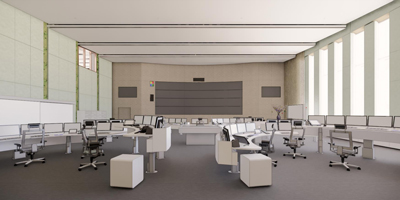
Experts as Partners – On the Way to the Control Center of the Future
The energy system is becoming increasingly complex – and so is its control. This creates new requirements for both the physical and digital work environment, as well as for collaboration within system operations. -
02 September 2025
50Hertz joins Energy Systems Integration Group (ESIG)
We are excited to announce that 50Hertz is now an official member of the Energy Systems Integration Group (ESIG)—a leading international community dedicated to advancing clean, reliable, and affordable energy systems through technical collaboration and innovation.