Open Source – New Opportunities and Challenges
Sven Fritzsche is Open Source Program Office (OSPO) Lead for Elia Group. In this article, he discusses the general context and specific opportunities of following an open source philosophy at 50Hertz and Elia:
As our digital maturity increases and our internal software development advances, we encounter new opportunities and challenges. One of them being open source technologies.
Every day, the pace of the energy transition and the pace of technological development advances with unprecedent speed. The world is becoming more complex, and it is moving faster and rougher than ever before. Naturally, utilities are right in the middle of this change. They need to keep up with the pace of change and navigate through increasing complexities.
To do so, Elia Group
- encourages the organization to increase cooperation and co-creation
- works on their own digital maturity by extending internal expertise and capabilities to use, develop, and contribute software built in-house.
Open source principles seem to be a great tool to advance both.
Simultaneously, digital sovereignty gains momentum and attention within our industry on a global scale. This is reflected in the developments of open source in the context of discussions around digital sovereignty. At European Level, as part of the of the overarching Digital Strategy of the Commission, the European Commission’s Open Source Software Strategy states that open source “promotes the sharing and reuse of software solutions, knowledge and expertise, to deliver better European services […] benefit society and lower costs to that society”. Moreover, in January 2026, the European Commission has launched a call for evidence on the upcoming European Open Digital Ecosystem Strategy – “an initiative that will support EU ambitions to secure technological sovereignty.”
In Germany, the Federal Office for Information Security (BSI) promoting IT Security sees open source a good means to that end because it enables:
- “Openness: Security vulnerabilities can be independently audited and fixed
- Customizability: Software adapts to security requirements, not the other way around
- Interoperability: Open standards enable smooth collaboration”
The BSI states that security is increased when using a wide range of operating systems and applications - “since it is easier and quicker to attack and inflict more damage on software monocultures. Therefore, the federal government's IT strategy aims to increase the diversity of software and reduce the number of monocultures. A wider selection of software also leads to greater manufacturer independence”.
On local level, in November 2024, the Federal State of Schleswig Holstein published its ”Open Innovation and Open Source Strategy”. It became the first federal state to pursue this path in Germany. As part of this, it “completed the migration of its state administration email system — comprising of more than 44,000 mailboxes and 110 million emails and calendar entries — to Open-Xchange and Thunderbird. The state also moved 80% of the ecosystem to the open source office suite LibreOffice”
By 2026, it has “already saved €15 million in licensing fees. After accounting for switching costs and other expenses, €9 million was reinvested into the open source ecosystem”.
Consecutively, in December 2025, the Federal State of Berlin presented its Open Source Strategy. “to boost its digital sovereignty, reduce reliance on proprietary vendors, and ensure long-term cost savings. The initiative aims for 70% open source software in administration by 2032.”
France is another: The country has committed itself to an open source strategy to strengthen digital sovereignty, reduce reliance on technology providers, and to fostering local innovation.
More concretely it is currently replacing applications such as Microsoft Teams and Zoom with Open-Source solutions
All of the above raise the following questions: What is open source and what are the advantages and disadvantages of open source in the space of critical infrastructure?
1. What is Open Source
Open source is a way to develop software code collaboratively.
There are four basic principles.
- The freedom to use the program as you wish, for any purpose
- The freedom to modify the program to do what you want it to do
- The freedom to redistribute copies.
- The freedom to distribute copies of modified versions to others
2. Advantages and disadvantages of open source (in general and in space of critical infrastructure)
On the one hand, open source software provides utilities with many benefits. They provide basic components freely – allowing utilities to access global expert knowledge, they are transparent and they have been tested many times.
On the other hand, open source solutions need to address concerns regarding security, compliance, regulation, and others. For many, opening to the outside world seems to contradict the requirements of security, compliance and control.
To address the concerns regarding open source while harvesting its benefits, we have established an Open Source Program Office (OSPO) at Elia Group. The goal of our OSPO is to create strong governance structures (e.g. code reviews, security scans, license management), so that we can benefit from the open source community while we contribute simultaneously to the benefit of the community and fulfill all our internal requirements.
3. The way forward
Today at Elia Group, the use of open source software has become indispensable. Both in software products Elia in Belgium (Elia) and at 50Hertz in Germany, many of the basic components of our in-house development are built from open-source packages. Furthermore, the programming languages themselves are open source.
Similarly, our peers in the utility world like RTE (French TSO), Stattnett (Norwegian TSO) or Alliander (Dutch DSO) use, develop and contribute software.
Therefore, we believe that sharing and collaboration create more robust, more secure, and more versatile building blocks. They meet the growing demands for digitalization and sovereignty to increase security and reliability.
As such, open source is not an end in itself, but a tool to develop digital solutions with greater speed and flexibility. To further validate this hypothesis, we have started pilot projects. Among them a controlled opening of individual modules, to leverage the advantages of open source - even in the highly critical environments of utilities.
Now, ask yourself: How does your company contribute to open source?
If you’re interested in exchanging ideas or want more information, let’s connect:
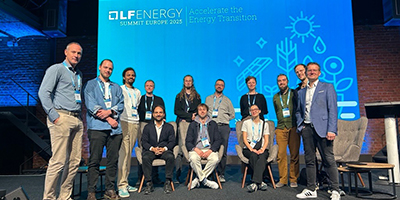
- Take a look at High-Level panel on Open Source from a utility perspectives (SwissGrid, RTE, 50Hertz) at the LF Energy Summit 2025
- Reach out to our OSPO: Sven Fritzsche


No results found
-
12 February 2026
Open Source, Open Minds: Utility Perspectives on Digital Collaboration
This high-Level panel at the LF Energy Summit 2025 in Aachen explores how Open Source offers new ways of efficient and scalable cooperation in the space of digitalization within utilities.